We Use CookiesWe use cookies to enhance the security, performance, functionality and for analytical and promotional activities. By continuing to browse this site you are agreeing to our privacy policy

10 Best Telescopes For Beginners 2026 in the United States
How do we rank products for you?

Our technology thoroughly searches through the online shopping world, reviewing hundreds of sites. We then process and analyze this information, updating in real-time to bring you the latest top-rated products. This way, you always get the best and most current options available.

headphones-stars

Our Top Picks

#1

Winner

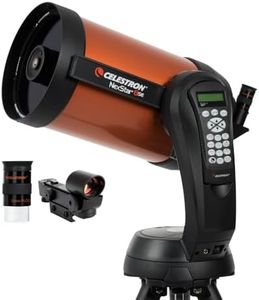
Celestron NexStar 8SE Computerized Telescope – 8-Inch Schmidt-Cassegrain Optical Tube – Fully Automated GoTo Mount with SkyAlign – Ideal for Beginners and Advanced Users – 40,000+ Object Database

Rating
10.0
Chosen by1,200
Portability
Eyepieces
Finderscope

Most important from
1562 reviews

Portability
Despite being a bit heavier than expected, the telescope is manageable and offers excellent portability for stargazing on the go.
Eyepieces
The included 25mm lens is impressive, especially when paired with a Barlow lens, enhancing the viewing experience significantly.
Finderscope
The red dot finder scope could be better, and many users suggest upgrading to a more precise optical finder with magnification.

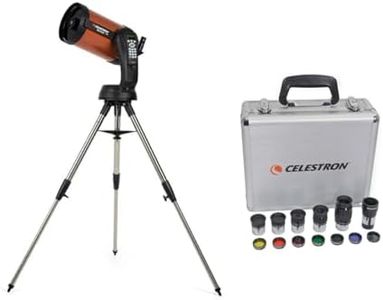
The Celestron NexStar 8SE Telescope is designed to cater to both beginners and experienced stargazers, making it a solid choice in the beginner telescope category. Its standout feature is the 8-inch aperture, which allows for excellent light gathering, providing clear views of celestial objects like planets and galaxies. This makes it suitable for those serious about exploring the night sky without compromising on portability due to its compact design.

The fully automated GoTo mount is another significant advantage, as it simplifies the stargazing experience by automatically locating and tracking over 40,000 celestial objects. This is great for beginners who may struggle with manual tracking. Additionally, the SkyAlign technology allows users to set up and align the telescope quickly, which is a plus for those new to astronomy.

However, there are some drawbacks to consider. While the telescope is easy to transport, the assembly process may be slightly cumbersome for complete novices, as it involves multiple components. Furthermore, the manual focus might take some getting used to, especially for users expecting a more automated experience. The relatively high price point could also deter some beginners who are just starting and may not want to invest heavily right away.

Rating
10.0
Chosen by1,200
Portability
Eyepieces
Finderscope

Most important from
1562 reviews

Portability
Despite being a bit heavier than expected, the telescope is manageable and offers excellent portability for stargazing on the go.
Eyepieces
The included 25mm lens is impressive, especially when paired with a Barlow lens, enhancing the viewing experience significantly.
Finderscope
The red dot finder scope could be better, and many users suggest upgrading to a more precise optical finder with magnification.
#2

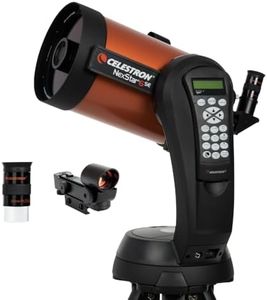
Celestron NexStar 6SE Computerized Telescope – 6-Inch Schmidt-Cassegrain Optical Tube – Fully Automated GoTo Mount with SkyAlign – Ideal for Beginners and Advanced Users – 40,000+ Object Database

Rating
9.4
Aperture
Mount Type
Portability

Most important from
974 reviews

Aperture
The 6-inch aperture provides increased resolution and clarity, making celestial objects like Jupiter and its moons appear crystal clear.
Mount Type
The GoTo feature makes it easier to find faint objects and is perfect for sharing with friends as it tracks automatically.
Portability
Setup and takedown are a snap, with the entire rig fitting in the boot of a MINI roadster, making it perfect for those who value portability.
Ease of Use
Aligning the viewfinder and setting up the scope is straightforward, thanks to the clear instructions and user-friendly design.

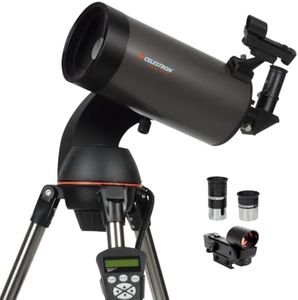
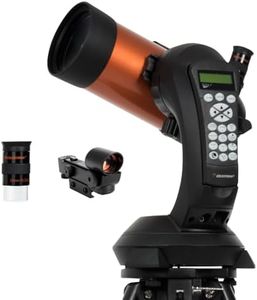
The Celestron NexStar 6SE Telescope offers a great blend of features for both beginners and advanced users. Its 6-inch aperture is substantial enough to provide clear and detailed views of the Moon, planets, and various deep-sky objects like the Orion Nebula. This makes it versatile for different stargazing interests. The telescope's focal length, combined with the 25mm eyepiece, offers good magnification, ensuring you can see celestial objects in impressive detail. It might require additional eyepieces for higher magnifications if you desire even closer views.

The fully-automated GoTo mount is a significant strength, especially for beginners. With a database of over 40,000 celestial objects, it automatically locates and tracks objects for you, saving you from the complexities of manual tracking. The SkyAlign technology further simplifies the setup process, making it user-friendly. Portability is decent; while the telescope is not ultra-light, its components can be broken down for easier storage and transport. At 21 pounds, it's manageable but may not be ideal for extended travel.

Ease of use is enhanced by the straightforward setup and alignment process, making it accessible for newcomers. The included Starry Night software is a nice bonus for planning and learning, adding educational value. On the downside, the telescope requires a CR2032 battery, and some users may find the manual focus slightly challenging to get precise views. In summary, the Celestron NexStar 6SE is a solid choice for beginners due to its powerful optics, automated tracking, and user-friendly setup, though it may require some additional accessories for optimal use.

Rating
9.4
Aperture
Mount Type
Portability

Most important from
974 reviews

Aperture
The 6-inch aperture provides increased resolution and clarity, making celestial objects like Jupiter and its moons appear crystal clear.
Mount Type
The GoTo feature makes it easier to find faint objects and is perfect for sharing with friends as it tracks automatically.
Portability
Setup and takedown are a snap, with the entire rig fitting in the boot of a MINI roadster, making it perfect for those who value portability.
Ease of Use
Aligning the viewfinder and setting up the scope is straightforward, thanks to the clear instructions and user-friendly design.
#3

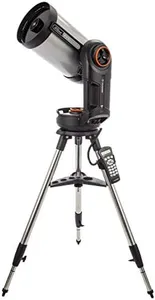
Celestron - NexStar Evolution 8 WiFi Enabled Computerized Telescope - 8” Schmidt-Cassegrain Telescope SCT - Control via Smartphone App - 10-Hour Lithium Battery - iPhone and Android Compatible

Rating
9.1
Magnification
Mount Type
Portability

Most important from
73 reviews

Magnification
Adding a selection of quality eyepieces enhances the viewing experience, offering versatility and better detail.
Mount Type
Computerized tracking and the SkyPortal app allow spending more time observing and less time searching, dramatically improving the stargazing experience.
Portability
The convenience of the built-in rechargeable battery and the smart altazimuth mount supports extended, cordless outdoor use.
Ease of Use
Setup is impressively quick and straightforward, requiring little to no instructions, making it accessible even for beginners.

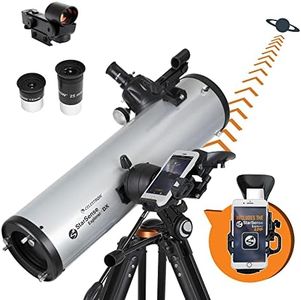
The Celestron NexStar Evolution 8 is a strong choice for beginners who want an easy and exciting way to explore the night sky. Its 8-inch aperture and 2032mm focal length mean it gathers a lot of light, providing bright, clear views of planets, the Moon, and deep-sky objects. The included Plossl eyepieces offer good magnification and a decent field of view for detailed observing. One of its biggest advantages is the computerized altazimuth mount that automatically finds and tracks objects, controlled via a smartphone app. This makes locating stars and planets simple, which is great for new stargazers who might feel overwhelmed by manual setups. The built-in 10-hour rechargeable lithium battery adds convenience for outdoor use without needing extra power supplies.

Portability is decent for an 8-inch SCT; the design includes carry handles and accessory trays, but at about 17.5 kg (38.5 lbs), it’s not ultra-light and may require some effort to transport. The manual focus is straightforward, though some beginners may find the narrow field of view typical of Schmidt-Cassegrain telescopes a bit limiting for wide star clusters or large nebulae. While the telescope excels in tracking accuracy and ease of use through the app, it comes with a learning curve to fully utilize its features.

This telescope provides a well-rounded option for beginners seeking a powerful, smart, and relatively portable instrument that can grow with their interest in astronomy.

Rating
9.1
Magnification
Mount Type
Portability

Most important from
73 reviews

Magnification
Adding a selection of quality eyepieces enhances the viewing experience, offering versatility and better detail.
Mount Type
Computerized tracking and the SkyPortal app allow spending more time observing and less time searching, dramatically improving the stargazing experience.
Portability
The convenience of the built-in rechargeable battery and the smart altazimuth mount supports extended, cordless outdoor use.
Ease of Use
Setup is impressively quick and straightforward, requiring little to no instructions, making it accessible even for beginners.

Buying Guide for the Best Telescopes For Beginners

Choosing a telescope for beginners can be an exciting journey into the world of astronomy. The right telescope can open up a whole new universe of stars, planets, and celestial objects for you to explore. When selecting a telescope, it's important to understand the key specifications that will affect your viewing experience. By knowing what each spec means and how it impacts your observations, you can make an informed decision that best suits your needs and interests.
ApertureAperture refers to the diameter of the telescope's main optical component, which can be a lens or a mirror. This spec is crucial because it determines how much light the telescope can gather. A larger aperture allows you to see fainter objects and more detail. Apertures are typically measured in inches or millimeters. For beginners, a telescope with an aperture of 70mm to 130mm is a good starting point. If you're interested in viewing planets and bright deep-sky objects, a larger aperture will be beneficial.
Focal LengthFocal length is the distance between the telescope's main optical component and the point where it forms an image. This spec affects the magnification and field of view. A longer focal length provides higher magnification but a narrower field of view, which is great for observing planets. A shorter focal length offers a wider field of view, making it easier to locate and view larger objects like star clusters. Beginners might prefer a telescope with a moderate focal length (around 500mm to 1000mm) for a balanced experience.
MagnificationMagnification is how much larger the telescope can make objects appear. It's determined by the combination of the telescope's focal length and the eyepiece used. While high magnification can be tempting, it's not always better. Too much magnification can make images blurry and hard to focus. For beginners, a telescope that offers a range of magnifications (from 20x to 200x) is ideal. This allows you to start with lower magnification to find objects and then increase it to see more detail.
Mount TypeThe mount is what supports the telescope and allows you to aim it. There are two main types: altazimuth and equatorial. Altazimuth mounts move up-down and left-right, making them simple and intuitive for beginners. Equatorial mounts are more complex but allow for easier tracking of celestial objects as the Earth rotates. For beginners, an altazimuth mount is usually recommended due to its ease of use. If you plan to do more advanced observations or astrophotography, you might consider an equatorial mount.
PortabilityPortability refers to how easy it is to transport and set up the telescope. This is important if you plan to take your telescope to different locations for better viewing conditions. Smaller telescopes are generally more portable and easier to handle. For beginners, a lightweight and compact telescope is ideal, especially if you need to carry it to a dark-sky site. Consider the weight and size of the telescope and its mount when making your choice.
Ease of UseEase of use encompasses how user-friendly the telescope is, including setup, alignment, and operation. Some telescopes come with features like computerized mounts or smartphone apps that help you locate and track objects. For beginners, a telescope that is easy to assemble and operate is crucial to avoid frustration. Look for models with clear instructions and intuitive controls. Features like a red dot finder can also make it easier to aim the telescope.

FAQ

Most Popular Categories Right Now