10 Best Beginner Telescopes 2026 in the United States

Related Products
Up to 25% off


Recommended lists


Our technology thoroughly searches through the online shopping world, reviewing hundreds of sites. We then process and analyze this information, updating in real-time to bring you the latest top-rated products. This way, you always get the best and most current options available.

Our Top Picks
Winner
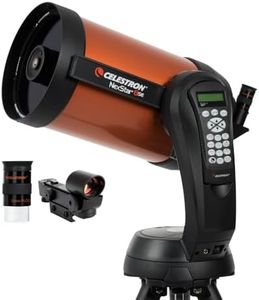
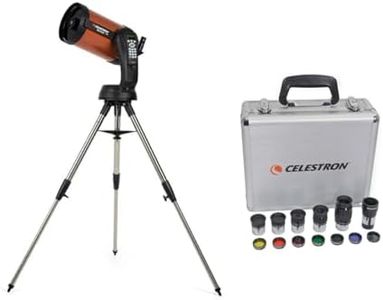
Celestron NexStar 8SE Computerized Telescope – 8-Inch Schmidt-Cassegrain Optical Tube – Fully Automated GoTo Mount with SkyAlign – Ideal for Beginners and Advanced Users – 40,000+ Object Database
Most important from
1562 reviews
The Celestron NexStar 8SE is a strong choice for beginners who want a telescope that’s easy to use yet powerful enough to grow with them. Its large 8-inch aperture gathers a lot of light, allowing you to see detailed views of the Moon, planets like Jupiter, and many deep-sky objects such as galaxies and star clusters. With a focal length of 2032mm, it provides good magnification potential for clear, sharp images. The fully computerized GoTo mount is a big help for beginners since it can automatically find and track over 40,000 celestial objects, so you don't need to learn star charts or manually aim the scope. Its SkyAlign technology makes setup quick by aligning the telescope using three bright stars, even if you don’t recognize them.
The included 25mm eyepiece offers a good starting point for viewing, and the StarPointer red dot finderscope helps you aim easily before the computer takes over. The mount type, a single fork arm with altitude-azimuth movement, is simple to operate but might feel a bit bulky to carry; at nearly 11 kilograms and with dimensions over half a meter tall, it’s portable but not ultra-light. Power options include batteries or external sources, but these extras are not included, so keep that in mind.
This telescope is well suited for beginners ready to invest in a serious instrument that offers ease of use combined with advanced features, although those looking for something lightweight and simple might find it a bit heavy and complex. The strong customer support and 2-year warranty add confidence for new users. The NexStar 8SE delivers excellent aperture and computerized convenience to help beginners explore the night sky with minimal hassle, though its size and power needs might require some extra preparation.
Most important from
1562 reviews
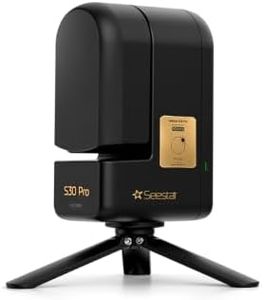
Seestar S30 Pro Smart Telescope 2026 Edition Black
The Seestar S30 Pro Smart Telescope is a user-friendly option designed especially for beginners interested in astronomy and astrophotography. Its 30mm aperture and 160mm focal length make it compact and lightweight (around 3.6 pounds), which is great for portability and casual outdoor use, like camping or travel. The alt-azimuth mount is simple to operate and also supports an equatorial mode, giving beginners flexibility as they learn. One of its standout features is the automatic GOTO system, which helps you locate and track celestial objects effortlessly through a smartphone app — a helpful tool if you’re new to stargazing. The built-in reflex finderscope assists with quick target alignment.
The telescope’s apochromatic optics reduce color distortion, providing sharper and higher-contrast views even in light-polluted urban areas, which is a common problem for city observers. It also includes useful light pollution filters. For those interested in astrophotography, the dual 4K camera setup and AI-powered imaging tools make capturing detailed photos of stars, planets, and the Milky Way easier without complicated setup.
While the 30mm aperture is modest and won’t gather as much light as larger beginner telescopes, limiting views of very faint deep-sky objects, the automatic focus and app controls simplify use. Beginners who want to learn manual settings might find some features limiting. The Seestar S30 Pro is particularly well-suited for absolute beginners who value easy setup, portability, and smart imaging capabilities, especially in urban environments, but those seeking more powerful light-gathering may want to consider larger apertures.
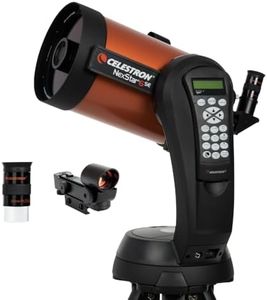
Celestron NexStar 6SE Computerized Telescope – 6-Inch Schmidt-Cassegrain Optical Tube – Fully Automated GoTo Mount with SkyAlign – Ideal for Beginners and Advanced Users – 40,000+ Object Database
Most important from
974 reviews
The Celestron NexStar 6SE Telescope is an excellent choice for both beginners and more experienced users looking to explore the night sky. One of its standout features is the 6-inch aperture, which allows for impressive views of celestial objects, from the Moon to deep-sky phenomena like the Orion Nebula. The computerized GoTo mount is a significant advantage; it can locate and track over 40,000 celestial objects for you, making stargazing much simpler, especially for newcomers to astronomy. The SkyAlign technology streamlines the setup process, allowing you to get started quickly, and it breaks down into manageable parts for easy storage, enhancing its portability.
On the downside, the NexStar 6SE can be somewhat heavy at 21 pounds, which may make it less convenient to transport for some users. While it’s designed to be user-friendly, the initial learning curve associated with using computerized mounts can be a little daunting for absolute beginners. Additionally, the included eyepiece is a basic 25mm lens; while it’s suitable for general use, you might find limitations and eventually want to invest in additional eyepieces for a broader range of viewing experiences.
The telescope also comes with a 2-Year warranty and superb customer support, which is reassuring for users. To enhance your experience further, it includes a free download of Starry Night software, allowing you to explore and simulate the night sky. This combination of features makes the NexStar 6SE a solid option for anyone looking to dive into astronomy, balancing portability and powerful performance.
Most important from
974 reviews
Buying Guide for the Best Beginner Telescopes
Choosing the right telescope as a beginner can be an exciting yet overwhelming experience. The key is to understand the basic specifications and how they align with your needs and interests. By focusing on these key specs, you can make an informed decision and find a telescope that will provide you with hours of stargazing enjoyment.FAQ
Most Popular Categories Right Now


