We Use CookiesWe use cookies to enhance the security, performance, functionality and for analytical and promotional activities. By continuing to browse this site you are agreeing to our privacy policy

10 Best Wifi Adapters 2026 in the United States
How do we rank products for you?

Our technology thoroughly searches through the online shopping world, reviewing hundreds of sites. We then process and analyze this information, updating in real-time to bring you the latest top-rated products. This way, you always get the best and most current options available.

headphones-stars

Our Top Picks

#1

Winner

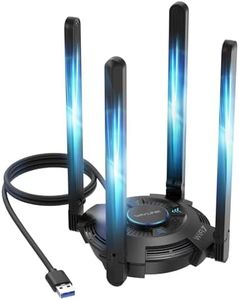
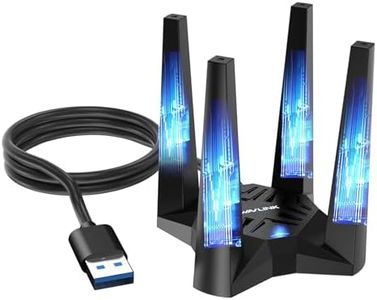
USB WiFi 7 Adapter for Desktop PC, WAVLINK BE6500 Tri-Band Wireless USB 3.0 Adapter with 4x5dBi High Gain Antenna, 2.4+5+6GHz, Multicolor Status LED, WPA3, MLO, OFDMA, 4K-QAM, Windows 11/10 Only

Rating
10.0
Chosen by1,226
Antenna Design
Speed Rating
Frequency Bands (2.4GHz vs 5GHz vs 6GHz)

Most important from
257 reviews

Antenna Design
The four high-gain antennas make a noticeable difference in signal strength and stability, ensuring a reliable connection.
Speed Rating
Gamers will appreciate the reduced lag and smoother gameplay, making it worth the investment for a frustration-free experience.
Frequency Bands (2.4GHz vs 5GHz vs 6GHz)
It enables strong connections even to nearby networks, demonstrating impressive range and sensitivity.

The WAVLINK Tri-Band BE6500 USB WiFi 7 adapter is designed for desktop users wanting to upgrade their internet connection to the latest WiFi 7 standard. It supports three frequency bands—2.4GHz, 5GHz, and the new ultra-fast 6GHz—offering speeds up to 2882Mbps on 5GHz and 6GHz bands and 688Mbps on 2.4GHz. This makes it suitable for high-bandwidth activities like 8K video streaming, online gaming, and large file transfers. The adapter uses a USB 3.0 interface, which ensures faster data transfer compared to older USB versions, helping to reduce lag and improve connection stability. Four high-gain 5dBi antennas boost signal strength and stability, and their foldable design helps with flexible placement to get the best coverage. The device also includes a colorful status LED for easy network monitoring and uses advanced security standards like WPA3, enhancing protection for your data.

This adapter supports only Windows 10 and Windows 11, with full benefits of the 6GHz band available on Windows 11 version 21H2 or later. It is not a WiFi signal booster or extender, so it doesn’t amplify weak router signals but provides a strong connection when paired with a compatible WiFi 7 router. The installation process is mostly plug-and-play due to a built-in driver, though manual installation might occasionally be required.

Weighing 550 grams and being fairly large, the adapter is better suited for desktop setups rather than portable use. For users with a modern Windows PC and a WiFi 7 router, this adapter offers fast, reliable wireless connectivity along with advanced features.

Rating
10.0
Chosen by1,226
Antenna Design
Speed Rating
Frequency Bands (2.4GHz vs 5GHz vs 6GHz)

Most important from
257 reviews

Antenna Design
The four high-gain antennas make a noticeable difference in signal strength and stability, ensuring a reliable connection.
Speed Rating
Gamers will appreciate the reduced lag and smoother gameplay, making it worth the investment for a frustration-free experience.
Frequency Bands (2.4GHz vs 5GHz vs 6GHz)
It enables strong connections even to nearby networks, demonstrating impressive range and sensitivity.
#2

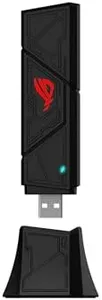
ASUS ROG USB-BE92 Tri-Band BE6500 WiFi 7 USB Adapter, 6GHz Band, Support 4096-QAM, Multi-Link Operation (MLO), Compatible with Type A and C, WPA3 Network Security

Rating
9.4
WiFi Standard (802.11)
Speed Rating
Frequency Bands (2.4GHz vs 5GHz vs 6GHz)

Most important from
90 reviews

WiFi Standard (802.11)
While connection to the new 6 GHz WiFi 7 band is currently intermittent, the adapter still offers impressive performance gains with existing bands and router features.
Speed Rating
This adapter completely resolved persistent Wi-Fi disconnections and instability, delivering near Ethernet-level speeds with flawless gaming performance.
Frequency Bands (2.4GHz vs 5GHz vs 6GHz)
Significant speed boosts on the 5 GHz band were observed, reaching 800 Mbps at a distance through walls, a dramatic improvement over previous Wi-Fi 6 adapters.
Compatibility (Operating System and Ports)
Plug-and-play setup with no extra drivers needed outside specific regions makes it incredibly user-friendly and hassle-free.

The ASUS ROG USB-BE92 is a modern WiFi adapter featuring the latest WiFi 7 (802.11be) standard, allowing very fast wireless speeds up to 6,500 Mbps. It operates on three frequency bands—2.4 GHz, 5 GHz, and the new 6 GHz band—providing less crowded and faster connections, especially on the 6 GHz band where interference is minimal. This makes it a solid choice for smoother video streaming, gaming, or transferring large files wirelessly.

The adapter uses a USB 3.0 form factor with support for both Type A and Type C ports, making it easy to connect to most modern computers without needing extra adapters. Its design supports advanced features like MU-MIMO and OFDMA, which help maintain strong connections in busy WiFi environments, such as offices or apartments with many devices. Security is up-to-date with WPA3 support, offering better protection against unauthorized access.

This adapter is ideal for users who want fast, future-proof wireless on desktops with USB ports and are ready to take advantage of WiFi 7 technology. While USB dongles may not have the same antenna strength as larger PCIe cards inside desktops, the ASUS ROG USB-BE92 provides a convenient and high-performance wireless solution.

Rating
9.4
WiFi Standard (802.11)
Speed Rating
Frequency Bands (2.4GHz vs 5GHz vs 6GHz)

Most important from
90 reviews

WiFi Standard (802.11)
While connection to the new 6 GHz WiFi 7 band is currently intermittent, the adapter still offers impressive performance gains with existing bands and router features.
Speed Rating
This adapter completely resolved persistent Wi-Fi disconnections and instability, delivering near Ethernet-level speeds with flawless gaming performance.
Frequency Bands (2.4GHz vs 5GHz vs 6GHz)
Significant speed boosts on the 5 GHz band were observed, reaching 800 Mbps at a distance through walls, a dramatic improvement over previous Wi-Fi 6 adapters.
Compatibility (Operating System and Ports)
Plug-and-play setup with no extra drivers needed outside specific regions makes it incredibly user-friendly and hassle-free.
#3

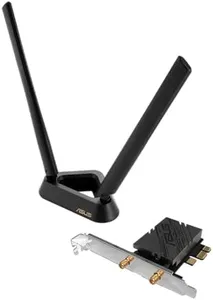
ASUS PCE-BE92BT WiFi 7 PCI-E Adapter with 2 External Antennas. Supporting 6GHz Band, 320MHz, Bluetooth 5.4, WPA3 Network Security, OFDMA and MU-MIMO, only Compatible with Intel motherboards

Rating
9.1
Frequency Bands (2.4GHz vs 5GHz vs 6GHz)
Antenna Design
Security Standards

Most important from
2634 reviews

Frequency Bands (2.4GHz vs 5GHz vs 6GHz)
Supports the 6 GHz band with ultra-low latency and minimal interference, enabling blazing-fast data rates ideal for bandwidth-intensive tasks and competitive gaming.
Antenna Design
The external antenna setup significantly enhances signal strength and range, providing stable and robust wireless coverage that rivals Ethernet speeds.
Security Standards
Advanced technologies like WPA3 security, OFDMA, and MU-MIMO ensure efficient, secure connectivity across multiple devices without compromise.
Compatibility (Operating System and Ports)
Installation is straightforward, but requires a PCIe x1 slot and an internal USB connection for Bluetooth, which may affect compatibility depending on your desktop setup.
WiFi Standard (802.11)
Backward compatibility with older WiFi standards maintains excellent speeds and signal strength even when paired with non-WiFi 6 devices.

The ASUS PCE-BE92BT is a PCI-E WiFi adapter designed for desktop users looking to upgrade to the latest WiFi 7 standard. It supports the new 6 GHz frequency band and offers a fast speed of up to 9.12 Gbps, which means it can handle heavy internet use with less congestion and interference compared to older WiFi versions. The adapter comes with two external antennas that help reduce dead zones by allowing you to position them for better signal reception. It also includes Bluetooth 5.4, which is energy-efficient and supports connecting several devices easily.

One of the adapter’s strengths is its support for advanced technologies like WPA3 for improved security, as well as OFDMA and MU-MIMO for better network efficiency when multiple devices are connected. The form factor as a PCI-E card means it's installed inside a desktop computer, which is a good choice for stable and fast connections compared to USB adapters.

However, a notable limitation is its compatibility: it only works with Intel motherboards, so users with AMD or other systems won’t be able to use this adapter. Also, since it’s meant for desktops and requires a PCI-E slot, it’s not suitable for laptops or those without available PCI-E connections. While it provides a very high-speed connection, users should ensure their router also supports WiFi 7 to fully benefit from this adapter. This adapter is ideal for Intel-based desktop users seeking cutting-edge WiFi 7 speeds and strong security, especially in environments with many devices or signal interference. Those with non-Intel setups or looking for simpler plug-and-play solutions might want to consider other options.

Rating
9.1
Frequency Bands (2.4GHz vs 5GHz vs 6GHz)
Antenna Design
Security Standards

Most important from
2634 reviews

Frequency Bands (2.4GHz vs 5GHz vs 6GHz)
Supports the 6 GHz band with ultra-low latency and minimal interference, enabling blazing-fast data rates ideal for bandwidth-intensive tasks and competitive gaming.
Antenna Design
The external antenna setup significantly enhances signal strength and range, providing stable and robust wireless coverage that rivals Ethernet speeds.
Security Standards
Advanced technologies like WPA3 security, OFDMA, and MU-MIMO ensure efficient, secure connectivity across multiple devices without compromise.
Compatibility (Operating System and Ports)
Installation is straightforward, but requires a PCIe x1 slot and an internal USB connection for Bluetooth, which may affect compatibility depending on your desktop setup.
WiFi Standard (802.11)
Backward compatibility with older WiFi standards maintains excellent speeds and signal strength even when paired with non-WiFi 6 devices.

Buying Guide for the Best Wifi Adapters

Choosing the right WiFi adapter can make a big difference in your internet experience, especially if you want fast, stable, and reliable wireless connections for your devices. There are many options available, so it's important to focus on your specific needs, the devices you use, and the environment in which you'll be connecting. Think about factors such as the type of WiFi you have at home, how far you are from your router, and what sort of activities (like streaming, gaming, or browsing) you mostly do. By understanding the main specifications of WiFi adapters, you’ll be able to find one that fits your usage and avoids common frustrations like slow speeds or dropped connections.
WiFi Standard (802.11)This spec shows which generation of WiFi technology the adapter supports, such as 802.11n, 802.11ac, or 802.11ax (also called WiFi 4, 5, and 6). Newer standards offer faster speeds, better range, and improved handling of many connected devices. Older adapters may only support 802.11n, which is slower, while newer ones may support 802.11ac or WiFi 6 with much higher performance. To pick the right one, check which WiFi standard your router supports. If you have a newer router or want a future-proof setup, choose an adapter that matches your router’s best standard, but don’t pay extra for standards your home network doesn’t support.
Speed RatingSpeed rating is usually measured in Mbps or Gbps and refers to the maximum theoretical data transfer rate the adapter can handle. Model descriptions might read as 300Mbps, 867Mbps, or 1.2Gbps. While higher speeds might look better, the real-world speed is often lower and also depends on your internet service and router. If you only browse and email, a lower speed is fine, but for 4K streaming or gaming, a higher rating ensures smoother performance. Match the speed to your router and internet plan, and choose higher ratings if your activities demand faster connections.
Frequency Bands (2.4GHz vs 5GHz vs 6GHz)WiFi adapters can connect to different radio bands, primarily 2.4GHz and 5GHz, with newer ones supporting 6GHz (WiFi 6E). 2.4GHz offers better range but is slower and more crowded, while 5GHz is faster but has a shorter range. 6GHz provides even faster and less congested channels if your router and adapter support it. If you live in a small space close to your router or have many nearby networks, a dual-band or tri-band adapter (covering both 2.4GHz and 5GHz, or 6GHz) is ideal. If you need to reach distant rooms, look for strong 2.4GHz support. Your usage scenario and network environment will guide which bands are most important.
Form Factor (USB, PCIe, etc.)WiFi adapters come in different shapes and connection types: USB, PCIe (for desktops), and sometimes M.2 (for laptops). USB adapters are portable and easy to use, great for laptops and desktops alike. PCIe adapters are internal and often more powerful, but need installation inside a desktop PC. Choose a USB adapter for plug-and-play use, portability, or if you’re not comfortable opening your computer. Opt for a PCIe model if you want the strongest performance and don’t mind a more involved setup on a desktop.
Antenna DesignSome adapters have built-in antennas while others have external, adjustable antennas. External antennas can provide better range and signal strength, which is useful for larger homes or if your device is far from the router. Built-in antennas are more compact and portable, suitable for laptops or where space matters. If you need better coverage or more stable connections, go for models with external antennas; if you prefer simplicity and portability, built-in antennas are fine.
Compatibility (Operating System and Ports)Make sure the WiFi adapter works with your device’s operating system (like Windows, macOS, or Linux) and that it fits the available ports (USB-A, USB-C, etc.). Compatibility issues can prevent the adapter from working at all or from using its full features. Always check what your computer supports before buying and pick an adapter that lists compatibility with your system.
Security StandardsThe security features (like WPA3, WPA2, or WEP) help keep your data safe on wireless networks. Newer security protocols are safer than older ones. If your network supports the most advanced standard, choose an adapter that does as well. For most people, adapters supporting at least WPA2 are essential, but WPA3 support is best for future safety.

FAQ

Most Popular Categories Right Now