10 Best Telescopes 2026 in the United States

Related Products
Up to 25% off
Our technology thoroughly searches through the online shopping world, reviewing hundreds of sites. We then process and analyze this information, updating in real-time to bring you the latest top-rated products. This way, you always get the best and most current options available.

Our Top Picks
Winner
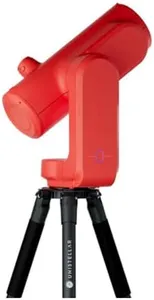
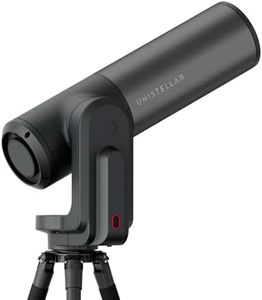
Odyssey PRO - UNISTELLAR Smart Telescope (with Eyepiece), 85mm f/3.9 (320mm) Digital & Computerized, App-Controlled Motorized Alt-Az, Enhanced Vision, RAW/FITS Export, 64GB, 5h Battery (Red)
Most important from
52 reviews
The Unistellar Odyssey PRO is a smart digital telescope designed to make stargazing easy and engaging, especially for beginners and casual astronomers who value convenience and modern tech. Its 85mm aperture and 320mm focal length offer a bright and relatively wide field of view, allowing you to see many celestial objects from city balconies or darker sites.
The motorized Alt-Azimuth mount with one-click GoTo and autofocus means you can start observing quickly without fiddling with manual alignment—just power it on, connect to the app, and go. A standout feature is the eyepiece technology unique to this model, which blends traditional viewing with digital enhancements for sharper, clearer images, and the option to view through your smartphone or tablet. The built-in 64GB storage and up to 5 hours of battery life support extended sessions and easy saving of your observations.
Weighing about 6.5 kg with tripod included, it remains portable enough for most users to carry to different locations. The 85mm aperture is modest compared to larger telescopes, limiting fine detail and deep-sky viewing capabilities somewhat. Advanced features like RAW image export and citizen science participation appeal to enthusiasts wanting more than just visual enjoyment, while those purely after manual control or very high magnification might find this system less flexible. The Odyssey PRO suits users looking for a high-tech, user-friendly telescope that combines visual and digital astronomy in a compact package.
Most important from
52 reviews
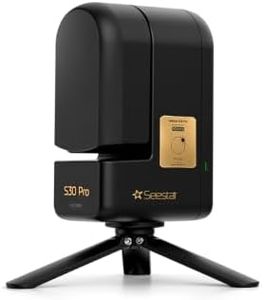
Seestar S30 Pro Smart Telescope 2026 Edition Black
The Seestar S30 Pro Smart Telescope is designed with beginners and casual stargazers in mind, offering an easy and enjoyable way to explore the night sky. Its 30mm aperture and 160mm focal length provide clear views of stars and planets, though the small aperture limits how much faint detail you can see compared to larger telescopes. A major plus is its smart features: it connects to your smartphone through an app, automatically finds and tracks celestial objects, and even lets you capture impressive 4K astrophotography images with just a tap. This makes it especially suitable for those new to astronomy who want to skip complicated setups.
The telescope’s apochromatic optics and built-in light pollution filters help reduce color distortions and improve visibility in city skies, a common challenge for urban users. Its alt-azimuth mount allows for easy movement, and it also supports equatorial mode for more precise tracking, which is a nice bonus for more serious hobbyists. Portability is a strong point; weighing just 3.64 pounds and with a compact design, it’s easy to take on trips, camping, or to darker locations. The included tripod and autofocus feature add to the convenience.
However, the small aperture means it won’t capture very faint deep-sky objects, and battery power limits long sessions without spare batteries. While the telescope excels in user-friendly smart imaging and portability, those looking for deeper sky exploration or higher magnification might find its specs limiting. For beginners and casual users seeking a modern, easy-to-use telescope with great photo features, the Seestar S30 Pro offers a compelling package.
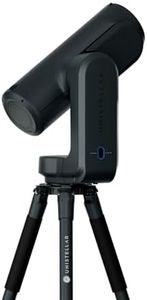
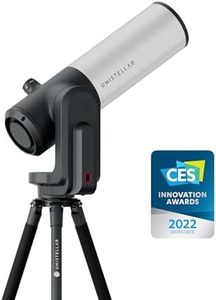
Odyssey - UNISTELLAR Smart Telescope (no Eyepiece), 85mm f/3.9 (320mm) Digital & Computerized, App-Controlled Motorized Alt-Az, Enhanced Vision, RAW/FITS Export, 64GB, Tripod, 5h Battery (Black)
Most important from
52 reviews
The Unistellar Odyssey smart telescope offers a fresh take on stargazing by combining an 85mm aperture with an f/3.9 (320mm focal length) optical system and a fully motorized Alt-Azimuth mount. Its standout feature is the digital, app-controlled viewing experience—there’s no traditional eyepiece. Instead, you observe through your smartphone or tablet, which simplifies setup and lets you easily share images with friends. This makes it ideal for beginners or casual users who want quick, hassle-free access to the night sky without learning complex alignment or focusing techniques.
The motorized mount and autofocus enable starting observations in under two minutes, with precise automatic pointing to thousands of objects from its built-in catalog. Portability is notable for a serious telescope, weighing about 6.5 kg with a premium tripod included, and it runs on a rechargeable battery lasting up to 5 hours—convenient for backyard sessions or light travel.
A downside is the lack of a traditional eyepiece, which means missing out on the classic visual experience through the lens, and reliance on a smartphone may not appeal to everyone, especially those wanting hands-on manual control or comfortable long viewing sessions. The 85mm aperture limits the detail and faint objects visible compared to larger telescopes, but it achieves a solid limiting magnitude of 17.2 thanks to its digital enhancements. For users interested in astrophotography or citizen science projects, the ability to export professional-grade RAW/FITS files and participate in NASA and SETI campaigns adds significant value. The Odyssey suits newcomers or tech-savvy stargazers who prioritize quick setup, portability, and interactive digital experiences over traditional optics.
Most important from
52 reviews
Buying Guide for the Best Telescopes
Choosing the right telescope can be a thrilling yet daunting task, especially if you're new to stargazing. The key to finding the best telescope for you is to understand the different specifications and how they align with your needs and interests. Whether you're interested in observing planets, deep-sky objects, or just want a general-purpose telescope, knowing what to look for will help you make an informed decision.FAQ
Most Popular Categories Right Now


