We Use CookiesWe use cookies to enhance the security, performance, functionality and for analytical and promotional activities. By continuing to browse this site you are agreeing to our privacy policy

10 Best Cycling Smart Trainers 2026 in the United States
How do we rank products for you?

Our technology thoroughly searches through the online shopping world, reviewing hundreds of sites. We then process and analyze this information, updating in real-time to bring you the latest top-rated products. This way, you always get the best and most current options available.

headphones-stars

Our Top Picks

#1

Winner

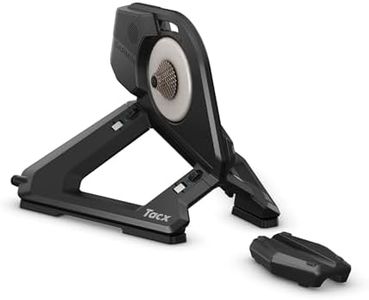
Garmin TacX NEO 3M Smart Trainer, Multidirectional Movement, Realistic Ride Fee

Rating
10.0
Chosen by1,138
Connectivity
Noise Level

Most important from
29 reviews

Connectivity
Connects well right out of the box compared to the finicky Neo 2T.
Noise Level
Amazing road feel, incredibly quiet operation, and fabulous erg mode when not using the training videos.

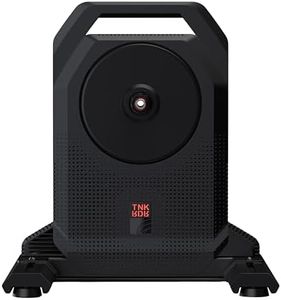
The Garmin TacX NEO 3M Smart Trainer is a feature-rich cycling smart trainer that offers a highly realistic riding experience. One of its standout features is the built-in integrated motion plates, which allow for multidirectional movement, mimicking the feel of riding on different terrains like cobblestone and gravel. This feature can be toggled on or off, providing versatility for various training environments. The trainer's power accuracy is impressive, with reliable measurements within 1% accuracy, making it suitable for serious cyclists aiming to track performance metrics like power, speed, and cadence precisely. Connectivity is another strong point, as it seamlessly integrates with popular apps like TrainerRoad and Zwift through Bluetooth and Wi-Fi, making virtual training sessions more engaging and stable even in group settings or virtual races.

Noise levels are kept to a minimum due to the magnetic resistance mechanism, ensuring a quiet training session. Compatibility is broad, with included adapters for different axle types and a pre-installed 11-speed cassette, so it's ready to use right out of the box. The maximum resistance of up to 2200 watts and the ability to simulate gradients up to 25% is ideal for those looking to train for tough climbs and intense workouts. However, the trainer is quite heavy at 52 pounds, which might make it challenging to move around. Additionally, it has a higher price point, reflecting its advanced features and realistic ride simulation. Despite these minor drawbacks, the Garmin TacX NEO 3M Smart Trainer is an excellent choice for serious cyclists looking for a high-quality, realistic, and versatile indoor training experience.

Rating
10.0
Chosen by1,138
Connectivity
Noise Level

Most important from
29 reviews

Connectivity
Connects well right out of the box compared to the finicky Neo 2T.
Noise Level
Amazing road feel, incredibly quiet operation, and fabulous erg mode when not using the training videos.
#2

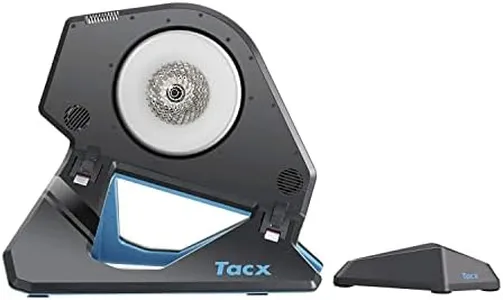
Garmin Tacx Neo 2T Smart Trainer

Rating
8.5
Power Accuracy
Noise Level
Flywheel Weight

Most important from
471 reviews

Power Accuracy
The trainer is durable, with no glitches after about 3,000 miles of use, and power measurements match closely with power meter pedals.
Noise Level
It's whisper-quiet, allowing for early morning or late-night rides without disturbing the neighborhood.
Flywheel Weight
The Neo trainers directly drive a custom-engineered BLDC motor, providing the correct inertia under all circumstances, unlike many other trainers.

The Garmin Tacx Neo 2T Smart Trainer is designed to offer a realistic and comfortable riding experience. Its ability to react instantly to speed or incline changes and allow for natural body movement makes it stand out in terms of providing a more natural cycling feel.

The new motor design enhances power delivery at low speeds, which is particularly beneficial for climbs and accelerations, contributing to a more engaging ride experience. With 32 integrated neodymium magnets, the trainer is equipped to handle high brake force and power levels, making it suitable for sprint training as well.

The descent simulation feature adds to the immersive experience when connected to an external power source, simulating downhill rides accurately. Additionally, it can operate in stand-alone mode, simulating a flat road where resistance increases with speed, which is useful for basic training without external power or connectivity.

Given its features, the Garmin Tacx Neo 2T Smart Trainer is well-suited for serious cycling enthusiasts looking for a high-performance, immersive training experience.

Rating
8.5
Power Accuracy
Noise Level
Flywheel Weight

Most important from
471 reviews

Power Accuracy
The trainer is durable, with no glitches after about 3,000 miles of use, and power measurements match closely with power meter pedals.
Noise Level
It's whisper-quiet, allowing for early morning or late-night rides without disturbing the neighborhood.
Flywheel Weight
The Neo trainers directly drive a custom-engineered BLDC motor, providing the correct inertia under all circumstances, unlike many other trainers.
#3

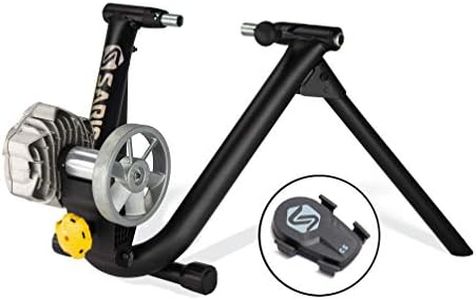
Saris Fluid2 Smart Equipped Indoor Bike Trainer, Includes Speed Sensor, Made in The USA

Rating
7.6
Resistance Type
Noise Level
Connectivity

Most important from
241 reviews

Resistance Type
The fluid resistance offers a realistic road-like feel with progressive resistance that adjusts naturally as you pedal harder.
Noise Level
The trainer delivers a smooth and quiet ride, making it easy to use indoors without disturbing others.
Connectivity
The included speed and cadence sensors work well with popular training apps, enhancing the indoor cycling experience.

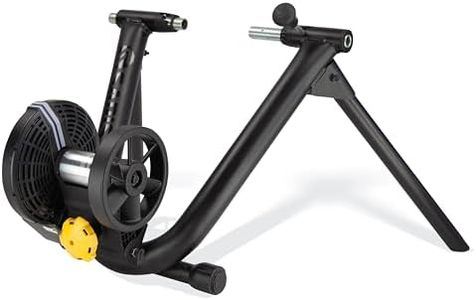
The Saris Fluid2 Smart Equipped Indoor Bike Trainer is a solid choice for cyclists looking to train indoors, especially with its fluid resistance system that offers a smooth and quiet ride—measured at about 69 decibels at 20 mph, which is relatively low noise for trainers. Its fluid resistance provides a realistic road-like feel, with a progressive resistance range that adjusts naturally as you pedal harder. This makes it suitable for riders wanting a genuine cycling experience. The included speed sensor and compatibility with popular training apps like Zwift and Rouvy, plus a one-month Rouvy subscription, add good connectivity for virtual rides.

The trainer fits most quick-release road bikes, but if you have a bike with a thru-axle, you'll need to buy a separate adapter, which is an extra cost and a small inconvenience. It’s a wheel-on trainer, so no need to remove your bike’s wheel, which is convenient, and it features a cooling system to help prevent overheating during longer sessions. While it doesn’t provide direct power measurement (meaning power accuracy isn’t as high as trainers with built-in power meters), it’s a reliable and durable option, backed by a limited lifetime warranty.

The trainer is relatively lightweight at 7.3 pounds and easy to store with its foldable frame. For cyclists seeking a quiet, realistic indoor training experience without a high price tag, the Saris Fluid2 Smart offers a dependable and well-rounded option. However, if the highest power accuracy is important for serious performance tracking, more advanced models may be preferable.

Rating
7.6
Resistance Type
Noise Level
Connectivity

Most important from
241 reviews

Resistance Type
The fluid resistance offers a realistic road-like feel with progressive resistance that adjusts naturally as you pedal harder.
Noise Level
The trainer delivers a smooth and quiet ride, making it easy to use indoors without disturbing others.
Connectivity
The included speed and cadence sensors work well with popular training apps, enhancing the indoor cycling experience.

Buying Guide for the Best Cycling Smart Trainers

Choosing the right cycling smart trainer can significantly enhance your indoor training experience. A smart trainer provides resistance that can be controlled by software, simulating real-world riding conditions. When selecting a smart trainer, it's important to consider several key specifications to ensure it meets your training needs and preferences. Understanding these specs will help you make an informed decision and get the most out of your investment.
Resistance TypeThe resistance type in a smart trainer determines how the trainer simulates different riding conditions. There are generally two types: magnetic and fluid. Magnetic trainers use magnets to create resistance, which can be adjusted electronically. Fluid trainers use a hydraulic fluid to create resistance, which increases as you pedal faster. Magnetic trainers are often quieter and offer more precise control, while fluid trainers provide a more realistic road feel. Choose magnetic if you want precise control and quieter operation, and fluid if you prefer a more natural riding experience.
Power AccuracyPower accuracy refers to how accurately the trainer measures your power output, usually expressed as a percentage. This is crucial for serious training as it ensures the data you are working with is reliable. Power accuracy typically ranges from ±1% to ±5%. For competitive cyclists or those following structured training plans, a higher accuracy (closer to ±1%) is preferable. For casual riders, a slightly lower accuracy may be acceptable. Consider your training goals to determine the level of accuracy you need.
ConnectivityConnectivity options determine how the smart trainer interacts with other devices and software. Common connectivity options include ANT+ and Bluetooth. These allow the trainer to connect to apps like Zwift, TrainerRoad, and others, as well as to heart rate monitors and other sensors. Ensure the trainer you choose supports the connectivity options you need for your preferred training apps and devices. If you plan to use multiple devices or apps, look for trainers with both ANT+ and Bluetooth capabilities.
Noise LevelNoise level is an important consideration, especially if you live in an apartment or train early in the morning or late at night. Trainers can vary significantly in how much noise they produce. Direct-drive trainers tend to be quieter than wheel-on trainers. If noise is a concern, look for trainers specifically marketed as quiet or with noise levels measured in decibels (dB). A quieter trainer will make your indoor training sessions more pleasant and less disruptive to others.
CompatibilityCompatibility refers to whether the smart trainer can accommodate your bike's specifications, such as wheel size, axle type, and drivetrain. Most trainers are compatible with a wide range of bikes, but it's important to check the specifications to ensure a proper fit. Some trainers come with adapters for different axle types and wheel sizes. Make sure the trainer you choose is compatible with your bike to avoid any issues during setup.
Maximum ResistanceMaximum resistance indicates the highest level of resistance the trainer can provide, usually measured in watts. This is important for simulating steep climbs and for high-intensity interval training. Trainers typically offer maximum resistance levels ranging from 1,000 to 2,200 watts. If you are a strong rider or plan to do a lot of high-intensity training, look for a trainer with a higher maximum resistance. For general fitness and moderate training, a lower maximum resistance may be sufficient.
Flywheel WeightThe flywheel weight affects the ride feel and inertia of the trainer. A heavier flywheel provides a smoother and more realistic road feel by maintaining momentum better. Flywheel weights can range from around 4 kg to over 10 kg. If you want a more realistic and smooth riding experience, opt for a trainer with a heavier flywheel. For casual training, a lighter flywheel may be adequate.

FAQ

Most Popular Categories Right Now